


The best time to visit Phu Quoc is November to March — dry season, calm seas, crystal-clear water, and ideal beach weather (27–31°C). The absolute peak is December to February. Avoid June to September when the southwest monsoon brings rough seas, heavy rain, and ferry cancellations. May and October are shoulder months — cheaper prices with acceptable conditions early in the month.
Phu Quoc — Vietnam’s largest island — has transformed over the past decade from a quiet fishing backwater into one of Southeast Asia’s most sought-after beach destinations. Pristine white sand beaches, turquoise water, vibrant coral reefs, and a rapidly expanding resort scene make it a genuine rival to Koh Samui, Bali, and Langkawi. But Phu Quoc’s island location in the Gulf of Thailand means its weather is governed by a strict monsoon cycle — and getting your timing wrong can mean rough seas, flooded beaches, and cancelled island-hopping tours.
This complete Phu Quoc weather by month guide tells you exactly when to go, what to expect, and how to make the most of every season. For the full Vietnam travel picture, see our best time to visit Vietnam guide.
What this guide covers:
- Best time to visit Phu Quoc for beaches, diving, and island hopping
- Phu Quoc weather by month — all 12 months with conditions and ratings
- Phu Quoc dry season vs rainy season — what actually changes
- Best beaches by season
- Budget tips — when prices drop and by how much
- What to do in Phu Quoc during the rainy season
Phu Quoc Climate Overview: Two Seasons, One Island
Unlike mainland Vietnam — which has three distinct climate zones — Phu Quoc has a straightforward two-season tropical climate driven entirely by the Gulf of Thailand monsoon pattern:
- Dry Season (November to April): Northeast winds keep the island sunny, dry, and calm. Seas on the west coast (Long Beach, Sao Beach) are flat and clear. This is peak tourist season with highest prices and largest crowds.
- Wet Season (May to October): The southwest monsoon arrives, bringing heavy rain, rough seas on the west coast, and reduced visibility for diving and snorkeling. Ferries to the An Thoi archipelago are frequently cancelled. Prices drop significantly.
| Month | Avg Temp | Sea Condition | Rainfall | Visibility (Diving) | Rating |
|---|---|---|---|---|---|
| Jan | 26–31°C | Calm ☀️ | Very Low | 15–20m ✅ | ★★★★★ |
| Feb | 26–32°C | Calm ☀️ | Very Low | 15–20m ✅ | ★★★★★ |
| Mar | 27–33°C | Calm ☀️ | Very Low | 15–20m ✅ | ★★★★★ |
| Apr | 28–34°C | Mostly calm ☀️ | Low | 10–15m ✅ | ★★★★☆ |
| May | 27–33°C | Getting rough ⚠️ | Medium | 5–10m ⚠️ | ★★★☆☆ |
| Jun | 26–31°C | Rough 🌧️ | High | 3–5m ❌ | ★★☆☆☆ |
| Jul | 25–30°C | Very rough ⛈️ | Very High | 2–3m ❌ | ★☆☆☆☆ |
| Aug | 25–30°C | Very rough ⛈️ | Very High | 2–3m ❌ | ★☆☆☆☆ |
| Sep | 25–30°C | Rough 🌧️ | High | 3–5m ❌ | ★★☆☆☆ |
| Oct | 26–31°C | Easing ⚠️ | Medium | 5–10m ⚠️ | ★★★☆☆ |
| Nov | 26–31°C | Calm returning ☀️ | Low | 10–15m ✅ | ★★★★☆ |
| Dec | 25–30°C | Calm ☀️ | Very Low | 15–20m ✅ | ★★★★★ |
☀️ = Calm & sunny | ⚠️ = Mixed conditions | 🌧️ = Rainy | ⛈️ = Very rough — avoid island hopping
Phu Quoc Weather by Month — Full Breakdown
January in Phu Quoc — ★★★★★ Peak Season
Best for: Beaches, diving, snorkeling, island hopping, sunset cruises
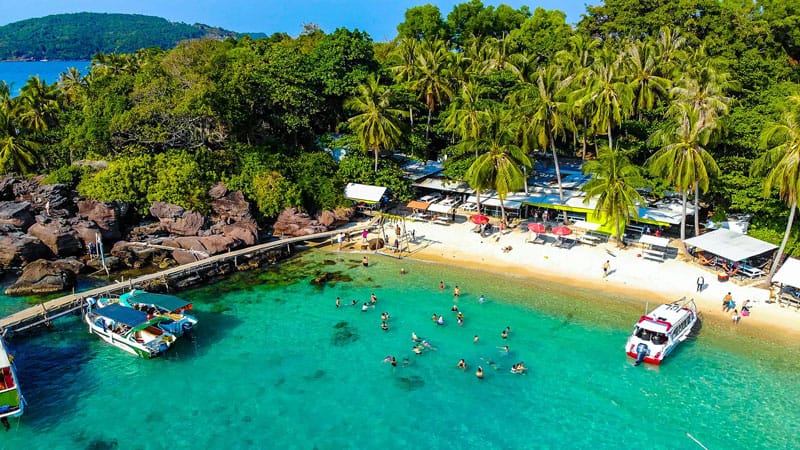
January is one of the finest months on the island. The northeast monsoon keeps skies clear and seas flat. Long Beach (Bai Truong) and Sao Beach (Bai Sao) are picture-perfect — calm turquoise water lapping white sand under cloudless skies. Underwater visibility reaches 15–20 metres, making this the best month for diving and snorkeling around the An Thoi archipelago. The island is busy and prices are at peak, but the conditions justify every cent.
- Temperature: 26–31°C
- Rainfall: Under 20mm — virtually none
- Sea: Flat and calm — ideal for all water activities
- Crowds: High — book accommodation 6–8 weeks ahead
- Prices: Peak — highest of the year
February in Phu Quoc — ★★★★★ Peak Season
Best for: Beaches, Vietnam Tet festival atmosphere, luxury resorts, diving
February mirrors January’s excellent conditions and adds the magic of Tet — Vietnam’s Lunar New Year. Resort areas around Duong Dong town fill with festive decorations. Seafood restaurants along the night market offer special Tet menus. Beach conditions remain flawless. One important note: some locally-owned restaurants and tour operators close for 3–5 days around Tet week — international resort restaurants and major tour companies remain open. This is the busiest and most expensive month on the island — pre-book everything.

- Temperature: 26–32°C
- Rainfall: Near zero
- Sea: Calm — excellent diving visibility (15–20m)
- Crowds: Very high — peak Tet holiday domestic travel
- Prices: Highest of the year — some resorts require 3-night minimums
March in Phu Quoc — ★★★★★ Ideal Month
Best for: First-time visitors, families, snorkeling, all beach activities
March is arguably the single best month to visit Phu Quoc for first-time visitors. Conditions are at their peak — warm but not oppressive (27–33°C), seas are flat, diving visibility is at its annual best, and Tet crowds have thinned. Prices ease slightly from the February peak. Sao Beach in the south of the island is particularly stunning in March — the water a vivid turquoise against bright white sand. Island-hopping tours to the An Thoi archipelago run daily without cancellation risk. This is the month that most international travel guides recommend for Phu Quoc — and for good reason.
- Temperature: 27–33°C
- Rainfall: Minimal — under 30mm
- Sea: Perfectly calm — best month for snorkeling and diving
- Crowds: Moderate — lower than Tet season
- Prices: Slightly below peak — best value in dry season
April in Phu Quoc — ★★★★☆ Very Good
Best for: Budget-conscious beach travelers, diving, avoiding peak crowds
April remains excellent but signals the approaching end of dry season. Temperatures climb (28–34°C) — the hottest month of the year on the island. Sea conditions are still largely calm, though occasional afternoon clouds begin building. Diving visibility remains strong (10–15m). Crowds and prices are noticeably lower than January–March. April is a smart pick for travelers who want dry-season conditions without paying peak-season prices.
- Temperature: 28–34°C — hottest month
- Rainfall: Low — occasional brief showers possible
- Sea: Mostly calm — still good for all water activities
- Crowds: Moderate and falling
- Prices: 10–15% below peak — good value
May in Phu Quoc — ★★★☆☆ Shoulder Season
Best for: Budget travelers, early wet-season deals, east coast beaches
May is the transitional month — the southwest monsoon arrives mid-month, and conditions deteriorate progressively through May. Early May (first two weeks) is still largely pleasant. Late May sees increasing rain, building swells on the west coast, and the first ferry cancellations to nearby islands. Prices drop 25–30% from peak. Savvy travelers who arrive in the first week of May and leave before the 20th can enjoy shoulder-season prices with near-dry-season conditions.
- Temperature: 27–33°C
- Rainfall: Medium and rising — heaviest late May
- Sea: Getting rough on west coast — east coast still manageable
- Crowds: Low — significantly fewer tourists
- Prices: 25–30% below peak
June in Phu Quoc — ★★☆☆☆ Wet Season Begins
Best for: Budget-only travel, indoor/cultural activities, east coast exploration
June marks the full arrival of the southwest monsoon on Phu Quoc. West coast beaches (Long Beach, Sao Beach) become choppy and unsafe for swimming. Island-hopping tours are frequently cancelled — operators may not refund if cancellation is weather-related. Diving visibility drops to 3–5 metres, making the reefs difficult to enjoy. The Phu Quoc Night Market remains open and lively, and inland attractions (Phu Quoc Prison, pepper farms, fish sauce factories) are unaffected by the rain. Prices hit their seasonal low.
- Temperature: 26–31°C
- Rainfall: High — daily afternoon and evening downpours
- Sea: Rough on west coast — ferry cancellations begin
- Crowds: Very low
- Prices: 35–40% below peak
July in Phu Quoc — ★☆☆☆☆ Avoid
Best for: Absolutely nothing beach-related — avoid if possible
July is the worst month to visit Phu Quoc. The southwest monsoon is at peak intensity — waves on Long Beach can reach 2–3 metres, making swimming dangerous. Rain is heavy, persistent, and comes in multiple daily sessions rather than the short afternoon bursts typical of Ho Chi Minh City’s wet season. Most snorkeling and diving operators suspend operations entirely. The inter-island ferries to the mainland (Ha Tien, Rach Gia) run reduced schedules. Even the airport sees weather-related delays. Prices are at their lowest, but the conditions make it the worst value for beach travel regardless of price.
- Temperature: 25–30°C
- Rainfall: Very high — heaviest month of the year
- Sea: Very rough — swimming dangerous, all tours cancelled
- Crowds: Minimal
- Prices: Lowest of the year — 40–50% below peak
August in Phu Quoc — ★☆☆☆☆ Avoid
Best for: Inland cultural activities only — not recommended for beach holiday
August is essentially a continuation of July — rough seas, persistent heavy rain, cancelled tours, and minimal beach viability. On the positive side, Phu Quoc does not face typhoon risk the way central Vietnam does (Da Nang, Hoi An, Hue), so the rain is monsoon-driven rather than storm-driven. Flooding is not typically a danger. But for a beach holiday, August is simply not a viable month. Pair this with our worst time to visit Vietnam guide if you are planning around difficult months.
- Temperature: 25–30°C
- Rainfall: Very high
- Sea: Very rough — dangerous for swimming
- Crowds: Minimal
- Prices: 40–50% below peak
September in Phu Quoc — ★★☆☆☆ Still Wet
Best for: Budget travel, indoor activities, east coast beaches on good days
September sees the monsoon begin to gradually ease — but conditions are still far from beach-ideal on the west coast. Rain is slightly less frequent than July–August, and there are occasional clearer spells. The east coast (Bai Thom) becomes increasingly accessible and can offer surprisingly pleasant conditions on calm days. Inland, the island’s forests and pepper plantations are lush and green at their most photogenic after months of rain. A good month for photography and nature walks.
- Temperature: 25–30°C
- Rainfall: High but decreasing
- Sea: Still rough on west coast — east coast improving
- Crowds: Low
- Prices: 35–40% below peak
October in Phu Quoc — ★★★☆☆ Shoulder Season
Best for: Budget-conscious travelers, early dry season deals, north and south Vietnam combo
October is Phu Quoc’s second shoulder month — the reverse mirror of May. The monsoon is retreating and conditions improve noticeably through the month. Early October is still wet and rough. Late October sees calmer seas returning to the west coast, rainfall dropping significantly, and the first signs of the brilliant dry-season weather ahead. Prices are still 20–30% below peak. Travelers who arrive in the last week of October can catch the opening of beach season at significantly reduced rates.
- Temperature: 26–31°C
- Rainfall: Medium and falling fast
- Sea: Improving — calm by late October
- Crowds: Low-moderate
- Prices: 20–30% below peak
November in Phu Quoc — ★★★★☆ Very Good
Best for: Value-seeking beach travelers, diving, avoiding peak crowds
November marks the return of Phu Quoc’s beach season. The northeast monsoon establishes itself, seas calm down on the west coast, and the famous crystal-clear water begins returning. Visibility for diving and snorkeling improves week by week through November. By mid-November, conditions are genuinely excellent — and prices are still 10–15% below the December peak. Island-hopping tours resume reliable daily schedules. November is one of the most underrated months on the island — great conditions at pre-peak prices.
- Temperature: 26–31°C
- Rainfall: Low and falling
- Sea: Calm and clearing — diving visibility 10–15m
- Crowds: Moderate — rising toward peak
- Prices: 10–15% below December peak
December in Phu Quoc — ★★★★★ Peak Season
Best for: Luxury beach holidays, diving, families, couples, island hopping
December is peak season in every sense. The northeast monsoon is fully established, delivering day after day of perfect beach weather — cloudless mornings, a light sea breeze in the afternoon, warm water (25–30°C), and spectacular sunsets over the Gulf of Thailand from Long Beach. Diving visibility is at 15–20 metres. Island-hopping tours run daily to the An Thoi archipelago. Starfish Beach is at its most accessible. The island fills up rapidly through December — especially the week between Christmas and New Year, when some resorts sell out months in advance.
- Temperature: 25–30°C
- Rainfall: Near zero
- Sea: Perfectly calm — peak diving season
- Crowds: Very high — book 2–3 months ahead for Dec 25–Jan 1
- Prices: Peak — Christmas/New Year week commands a premium
Phu Quoc Dry Season vs Rainy Season: What Actually Changes?
| Dry Season (Nov–Apr) | Rainy Season (May–Oct) | |
|---|---|---|
| West coast beaches | ✅ Calm, swimmable, stunning | ❌ Choppy to dangerous — avoid |
| East coast beaches | ⚠️ Windier — less ideal | ✅ Calmer — local secret |
| Diving & snorkeling | ✅ 15–20m visibility — excellent | ❌ 2–5m visibility — poor |
| Island hopping tours | ✅ Daily — reliable | ❌ Frequently cancelled |
| Sunset from Long Beach | ✅ Spectacular every evening | ⚠️ Often cloudy — occasional breaks |
| Prices | Peak — highest of the year | ✅ 25–50% cheaper |
| Crowds | High — book ahead | ✅ Low — almost empty beaches |
| Night market & dining | ✅ Fully open, lively | ✅ Open — less crowded |
| Inland attractions | ✅ All accessible | ✅ Lush & green — great for nature |
| Typhoon risk | None | None (south Vietnam protected) |
Best Beaches in Phu Quoc by Season
Dry Season Beaches (November–April)
- Sao Beach (Bai Sao): The most photographed beach in Phu Quoc — powdery white sand and vivid turquoise water. Best November–March when the water is calmest and clearest.
- Long Beach (Bai Truong): The main beach strip with resorts, restaurants, and the famous sunset view. At its best December–February for flat-calm water and spectacular evening skies.
- Ong Lang Beach: A quieter, tree-lined stretch popular with boutique resort guests. Excellent March–April when it is less crowded than Sao Beach.
- Starfish Beach: Accessible only by island-hopping boat tour to the An Thoi archipelago. Only visit November–April — tours cancel June–September.
Wet Season Beaches (May–October)
- Bai Thom (Northeast Coast): A wild, undeveloped beach that faces away from the monsoon wind — calmer than the west coast May–September. Minimal facilities but spectacular scenery.
- Ganh Dau Beach (North): The northernmost beach, partially sheltered from southwest swells. More accessible than Bai Thom — a local favourite during the wet season.
Best Time for Diving & Snorkeling in Phu Quoc
Phu Quoc sits at the edge of one of Vietnam’s richest marine ecosystems. The reefs around the An Thoi archipelago (15 islands south of Phu Quoc) host over 360 coral species and abundant marine life including sea turtles, reef sharks, and manta rays. But only visit during the right season:
- Best diving months: December, January, February, March — peak visibility 15–20 metres, calmest seas, most reliable boat access
- Good diving months: November, April — visibility 10–15 metres, conditions largely fine
- Acceptable diving: May, October — visibility drops to 5–10 metres, seas sometimes rough
- Avoid diving: June, July, August, September — visibility 2–5 metres, many operators suspend operations, boats frequently grounded
Phu Quoc in the Rainy Season: What to Do
Visiting Phu Quoc between May and October? You can still have a good trip — just reset your expectations and focus on what the island does well in the wet season:
- Phu Quoc Prison (Coconut Tree Prison): A powerful historical site documenting the Vietnam War — fully accessible and highly recommended year-round.
- Pepper farms and fish sauce factories: Phu Quoc is famous for both. Farm tours run regardless of weather and are fascinating cultural experiences.
- Phu Quoc Night Market (Dinh Cau Night Market): Open every night — the wet season actually makes this more enjoyable as the tourist crowds thin dramatically and prices at seafood stalls are more negotiable.
- Phu Quoc National Park: The island’s forested interior is lush, green, and atmospheric in the wet season. Birdwatching is excellent July–September.
- Vinpearl Land & Safari: Indoor and covered entertainment options that work in any weather. Good for families on rainy days.
- East coast exploration: Bai Thom and Ganh Dau are calmer in the wet season and far less visited — bring a motorbike and explore at your own pace.
How Much Do Phu Quoc Prices Change by Season?
| Season | Months | Budget Hotel | Mid-range Resort | Luxury Resort | vs Peak |
|---|---|---|---|---|---|
| Ultra Peak | Dec 24 – Jan 5 | $40–70 | $150–250 | $400–800+ | Highest |
| Peak | Jan–Mar, Feb | $25–50 | $100–180 | $300–600 | Base |
| High | Nov, Apr | $20–40 | $80–140 | $200–400 | –15–20% |
| Shoulder | May, Oct | $15–30 | $60–100 | $150–300 | –30–40% |
| Low | Jun, Sep | $10–20 | $40–70 | $100–200 | –50–60% |
| Rock Bottom | Jul–Aug | $8–15 | $30–60 | $80–150 | –60–70% |
Prices are approximate USD estimates. Luxury resort rates vary widely by property.
Phu Quoc vs Vietnam’s Other Beach Destinations by Season
Not sure whether Phu Quoc is the right beach for your travel dates? Here is how it compares to Vietnam’s other major beach destinations across the year:
- Phu Quoc (south): Best November–April | Avoid June–September
- Da Nang / Hoi An (center): Best February–May | Avoid September–November — see our best time to visit Hoi An guide
- Nha Trang (south-center): Best February–September | Avoid October–December
- Ha Long Bay (north): Best October–April | Avoid July–August — see our Ha Long Bay cruise guide
The key takeaway: Phu Quoc and Da Nang have almost opposite peak seasons. If you are visiting Vietnam May–September, Da Nang is closing and Phu Quoc is rough — the south’s urban destinations (Ho Chi Minh City, Mekong Delta) become your best options. For the full Vietnam weather by month breakdown across all destinations, see our dedicated guide.
Frequently Asked Questions
What is the best time to visit Phu Quoc?
The best time to visit Phu Quoc is November to March, with December to February being the absolute peak. Seas are calm, skies are clear, and beaches are at their finest. March offers the best balance of excellent conditions and slightly lower prices than the January–February peak.
Is Phu Quoc good in April?
Yes — April is still a very good month for Phu Quoc. Conditions are warm (28–34°C), seas are mostly calm, and diving visibility is solid (10–15m). Prices are 10–15% below the January–March peak. The main downside is that April is the hottest month of the year and occasional afternoon clouds begin building. A good pick for budget-conscious travelers who want dry-season conditions.
Is Phu Quoc worth visiting in the rainy season?
Phu Quoc in the rainy season (May–October) is only recommended for travelers who are not primarily seeking beaches. The island’s inland attractions — pepper farms, fish sauce factories, Phu Quoc Prison, the national park — are enjoyable year-round. If a beach holiday is your primary goal, visit November–April. If you want to save money and do not mind rain, consider Ho Chi Minh City and the Mekong Delta as your main base, with a short Phu Quoc visit in early May or late October.
What is the weather like in Phu Quoc in December?
December is one of the best months in Phu Quoc. Temperatures sit at 25–30°C — warm but not oppressive. Seas are flat and clear, diving visibility reaches 15–20 metres, and Long Beach delivers spectacular sunsets daily. The island fills up significantly from mid-December onward, and the Christmas–New Year week is the busiest and most expensive time of year. Book well in advance for December visits.
Does Phu Quoc get typhoons?
No — Phu Quoc rarely faces direct typhoon impact. The island sits in the Gulf of Thailand, which is largely shielded from the South China Sea typhoon track by the Vietnamese and Cambodian coastline. This is a key advantage over central Vietnam destinations like Hoi An and Da Nang, which face serious typhoon risk July–November. Phu Quoc’s wet season is monsoon-driven, not typhoon-driven — wet and rough, but not dangerous in the same way.
How does Phu Quoc weather compare to the rest of Vietnam?
Phu Quoc follows South Vietnam’s two-season tropical pattern — dry November to April, wet May to October. Unlike Hanoi, it has no cold winter. Unlike Hoi An, it has no typhoon risk. Its wet season is gentler than central Vietnam’s but rougher for beach activities than Ho Chi Minh City. For the full comparison, see our Vietnam weather by month guide.
Conclusion: Best Time to Visit Phu Quoc
The best time to visit Phu Quoc is clear — November to March for the finest beach conditions, and December to February for the absolute peak experience. Here is the final summary:
- Best months: December, January, February, March — calm seas, clear water, sunny skies
- Best for diving: December–March — 15–20m visibility, calm conditions
- Best value month: November or April — near-peak conditions at 10–15% less
- Shoulder season: May and October — 25–35% cheaper, conditions acceptable early/late in the month
- Avoid: June, July, August, September — rough seas, heavy rain, most tours cancelled
- Secret sweet spot: Last 10 days of October — seas calming, prices still low, crowds minimal
Phu Quoc is one of Southeast Asia’s most rewarding island destinations — but only when you time it right. Plan within the November–March window and you will experience the island at its spectacular best. For the complete Vietnam trip-planning guide including all regions and seasons, visit our best time to visit Vietnam guide.
0 Comment